250 Years of Liberty – Part I: The Idea That Changed the World
As America celebrates the 250th anniversary of its independence, we reflect on the revolutionary ideas that changed history. In Part I of our '250 Years of Liberty' series, we explore the Declaration of Independence, the founding principles of the American republic, and why the United States remains the world's greatest experiment in self-government. Discover how the Founders' vision of individual liberty, natural rights, and government by the consent of the governed continues to shape America 250 years later.

Two hundred fifty years ago, a group of men gathered in Philadelphia and did something the world had never seen before.
They did not merely declare independence from a king. They declared independence from an idea.
For thousands of years, civilization had largely operated under the assumption that power flowed downward. Kings ruled because of birth. Emperors ruled because of conquest. Governments existed because those in authority claimed the right to command those beneath them.
The Declaration of Independence turned that assumption upside down.
Instead of asking, Who has the right to rule? The Founders asked a far more radical question: What gives anyone the right to rule at all?
Their answer changed history.
“We hold these truths to be self-evident, that all men are created equal…”
Those words are among the most familiar ever written, but their significance is easy to overlook.
The Declaration did not claim that all people are equally talented, equally wealthy, or equally successful. It made a much more profound claim.
Every human being possesses inherent dignity. Every individual possesses rights that exist before the government. And because those rights are not created by government, government cannot rightly take them away except through due process and the rule of law. That was REVOLUTIONARY.
Governments had long argued that rights came from rulers. The American Founders argued that rulers derived their authority from the people.
As the Declaration continues,
“…that they are endowed by their Creator with certain unalienable Rights…”
Whether one approaches those words from a religious or philosophical perspective, the principle remains remarkable.
Rights are not permissions. They are not gifts from Congress. They are not favors granted by presidents, governors, or judges. They belong to every individual simply because they are human.
Government exists to secure those rights, NOT invent them.
That single idea remains one of America’s greatest contributions to political thought.
An Experiment Unlike Any Before
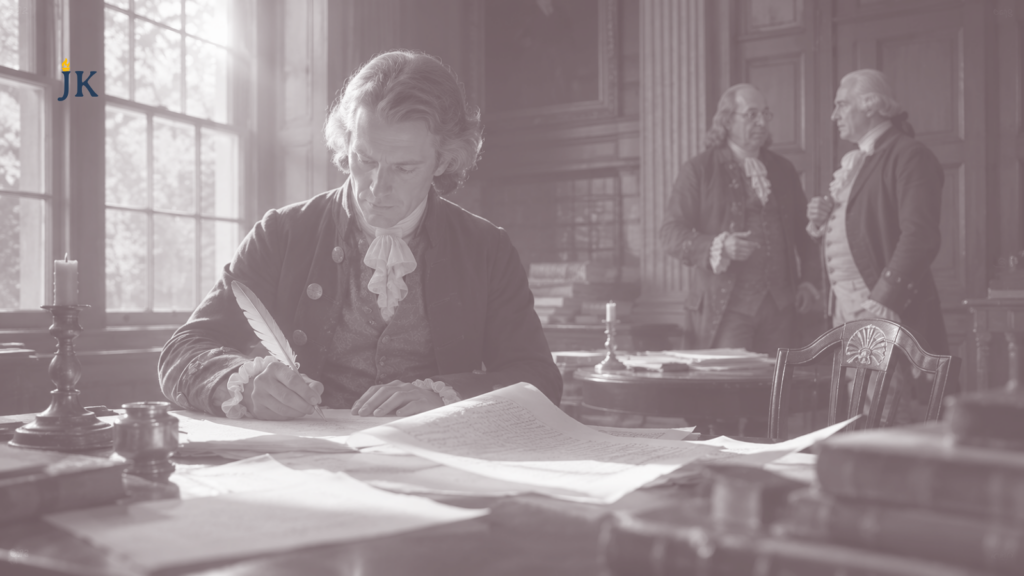
The American Revolution was not the first revolution in history, but it was one of the first to place principles above personalities.
The Declaration is striking because it spends very little time talking about Americans. Instead, it speaks about humanity. It appeals not merely to colonial grievances but to universal truths. It assumes that if these principles are true for Americans, they must also be true for everyone else.
That is why the Declaration has inspired people far beyond our own shores.
It has been cited by reformers, abolitionists, suffragists, dissidents, and freedom movements around the world.
Not because America has always perfectly lived up to its ideals, but because the ideals themselves transcend any single generation.
The Founders understood something we sometimes forget.
The principles were meant to judge the nation, not the other way around.
When America failed to uphold liberty, later generations did not abandon the Declaration; they appealed to it.
The very document that announced American independence also provided the standard by which Americans could hold their own government accountable. That may be its GREATEST achievement.
Liberty Begins with Humility
The Declaration is often celebrated for its confidence. I admire it for its humility.
The signers were not proclaiming their own greatness. In fact, they concluded by pledging,
“…our Lives, our Fortunes and our sacred Honor.”
They understood that the experiment might fail. Many of them would lose property. Some would lose family members. Several would die before ever seeing the Constitution drafted. None of them knew whether history would remember their names.
Yet they believed that liberty WAS WORTH THE RISK.
That willingness to sacrifice reminds us that freedom has never been free. Every generation inherits liberty. Every generation must decide whether it is willing to preserve it.
The American Experiment

The Founders did not believe they had created a perfect system. If anything, they assumed exactly the opposite. Human beings are imperfect. Governments are imperfect. Political disagreements are inevitable.
The question was never whether America would experience conflict. The question was whether a free people could resolve those conflicts without surrendering the principles that made them free in the first place.
That REMAINS the American experiment.
It is an experiment unlike a scientific test conducted in a laboratory.
It has unfolded over two and a half centuries. It has survived war. Economic collapse. Political realignments. Expansion. Division. Civil war. World wars. Terrorism. Technological revolutions. Periods of extraordinary leadership and moments of profound failure.
Still, the central proposition endures.
Free people REMAIN capable of governing themselves. That proposition should never be taken for granted.
History is filled with societies that surrendered liberty in exchange for security, comfort, or certainty. The American experiment has ALWAYS asked something harder.
It asks citizens to accept responsibility alongside freedom. It asks us to persuade rather than compel. To debate rather than silence. To participate rather than withdraw.
Liberty REQUIRES effort. That is precisely why it is so valuable.
250 Years Later

This Fourth of July marks the 250th anniversary of American independence.
For some, it is tempting to measure America only by today’s headlines.
Political division. Economic uncertainty. International conflict. Distrust of institutions.
Those challenges are real, but they should not blind us to something extraordinary.
For 250 years, the central American idea has endured.
Governments STILL derive their just powers from the consent of the governed. Citizens STILL possess the freedom to criticize those in authority. Power STILL changes hands through elections instead of revolutions.
The Constitution REMAINS the supreme law of the land.
The Declaration continues to remind us that government exists for the people, not the other way around.
No nation is perfect. America never claimed to be.
Our greatness has never rested upon perfection. It has rested upon our willingness to measure ourselves against principles that are higher than politics.
The Declaration of Independence did not promise that every generation would succeed.
It simply reminded every generation what SUCCESS ought to look like.
Two hundred fifty years later, that REMAINS worth celebrating. Not because our work is finished, but because the experiment continues.
And its next chapter belongs to us.
“The cause of America is in a great measure the cause of all mankind.” — Thomas Paine

Other Parts in the ‘250 Years of Liberty’ Series:
- Part Two: Why the Founders Distrusted Power
- Part Three: Freedom Requires Virtue
- Part Four: Why the American Experiment Still Works
- Part Five: The Next 250 Years

Jeramy Kitchen
Holding the line in Austin. Analysis of public policy making its way through the process, campaign finance, and the occasional field note from a concerned taxpayer.