Killdozer Day and the Fragile Line Between Liberty & Desperation
Killdozer Day is often remembered as a symbol of rebellion against government overreach, but its deeper lesson is about liberty, property rights, due process, and the dangers of citizens losing faith in peaceful remedies. The story of Marvin Heemeyer and Granby, Colorado, should not be treated as a celebration of destruction, but as a warning about what happens when local government power appears arbitrary, unaccountable, and disconnected from the people it governs.
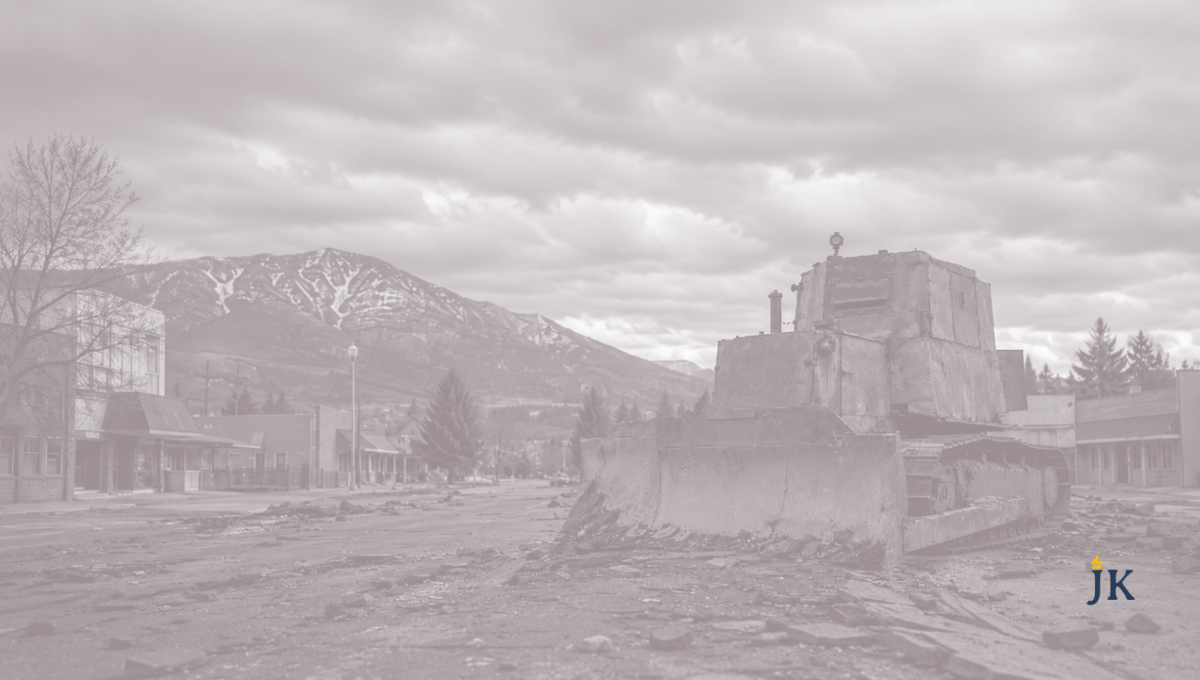
Every year on June 4, the internet revives what has come to be known as “Killdozer Day.”
For some, it is treated almost like an anti-government folk holiday. A man wronged by local officials. A small business owner pushed too far. A bulldozer turned into a symbol of defiance.
But the real lesson is more complicated than the meme.
On June 4, 2004, Marvin Heemeyer drove a heavily armored bulldozer through Granby, Colorado, destroying buildings connected to local government, the local newspaper, private businesses, and individuals he believed had wronged him. The rampage lasted roughly two hours, destroyed or damaged 13 buildings, and caused millions of dollars in damage. Thankfully, no innocent person was killed, though Heemeyer ultimately took his own life after the bulldozer became stuck.
That fact alone has helped fuel the mythology. Because no one else died, some have treated the story as a clean act of rebellion against an unjust system.
It was not.
Heemeyer was a muffler shop owner who had spent years in disputes with local officials, neighboring property owners, and others in the community. Those disputes involved zoning decisions, property access, fines, sewer and septic issues, and a neighboring concrete plant. Over time, Heemeyer came to view the town, the local newspaper, and various private actors as part of a coordinated effort against him. He secretly spent months armoring a Komatsu bulldozer with layers of steel and concrete, outfitting it with cameras and gun ports, and preparing for an act of vengeance.
That context matters because the Killdozer story has become a kind of Rorschach test.
Some see a folk hero. Others see a dangerous criminal. Some see a victim of corrupt local government. Others see a man who convinced himself that every setback, dispute, and legal defeat was evidence of persecution.
The truth is likely less useful for memes and more useful for serious reflection.
A liberty-minded view of Killdozer Day should be clear-eyed enough to hold two truths at once.
First, government abuse is real.
Local governments are often the level of government people experience most directly. They control permits, zoning, land use, code enforcement, business rules, inspections, fines, variances, and appeals. When those powers are exercised fairly, transparently, and narrowly, citizens may disagree with the outcome, but they can still recognize the legitimacy of the process.
But when local government becomes arbitrary, political, petty, or captured by insiders, it can make ordinary citizens feel powerless.
A zoning board can destroy property value. A code enforcement regime can bury a small business in fines. A permitting process can become a weapon. A connected developer can appear to receive treatment an ordinary property owner would never get. A city council can hide behind process while ignoring the real-world burden its decisions impose.
That does not mean every grievance is valid, but it does mean citizens have good reason to be suspicious of concentrated local power, especially when it is exercised with little transparency and few meaningful checks.
This is where the Killdozer story continues to resonate.
It reflects a broader frustration many Americans have with institutions that seem too insulated, too self-protective, and too willing to tell citizens: “That is just the process.”
For property owners and small business owners, “the process” can become the punishment.
Second, violence and destruction are not liberty. This point should NOT be softened.
Heemeyer did not merely protest. He did not simply expose corruption. He did not peacefully resist unjust treatment. He turned a private grievance into a violent rampage that destroyed property, endangered lives, and terrorized a town.
The fact that no innocent person died does not make the act righteous. Contemporary accounts note that officers and others were fired upon during the rampage, and the fact that no bystanders were killed appears to be the result of evacuation, timing, and luck more than restraint.
Liberty cannot survive if every person who believes he has been wronged is entitled to become judge, jury, and wrecking crew.
Property rights do not end where personal anger begins. Due process does not become optional because someone believes the system failed him. Limited government does not mean private vengeance. A free society depends not only on restraining government power, but also on restraining the impulse to answer injustice with destruction.
That is the balance Killdozer Day should force us to confront.
It is possible to recognize why the story resonates without celebrating what happened. It is possible to condemn Heemeyer’s actions while also admitting that local government can become abusive. It is possible to reject political violence while still demanding reforms that protect citizens from bureaucratic arrogance. And it is possible to understand that memes often emerge where trust has already broken down.
The deeper implication for liberty is this: people must have peaceful remedies that actually mean something.
Citizens need more than theoretical rights. They need practical ways to defend those rights when government oversteps. That means stronger protections for private property, clearer limits on zoning authority, more transparent local decision-making, easier access to records, meaningful appeal processes, stricter conflict-of-interest rules, and real consequences when public officials abuse their authority.
It also means remembering that local government is still government.
Too often, conservatives and libertarians focus heavily on Washington, D.C., while ignoring city councils, county governments, appraisal districts, school boards, water districts, zoning boards, and special-purpose governmental entities. Yet these are often the institutions that most directly affect whether a person can use his land, operate his business, afford his home, or challenge an official decision.
The local level is where liberty is either protected in practice or suffocated by a thousand small rules.
Killdozer Day should also be a warning to public officials.
People can tolerate losing. They can tolerate disagreement. They can tolerate rules they do not like, at least for a time. What they cannot tolerate forever is a system that appears rigged, dismissive, inaccessible, or contemptuous of the people it governs.
Government legitimacy depends on more than legal authority. It depends on fairness, restraint, transparency, and accountability.
When citizens believe the government is no longer listening, they lose faith in the normal channels of reform. When they believe the process is stacked against them, they stop trusting the process. When they believe every appeal is futile, resentment hardens into something darker.
That does not excuse violence, but it should alarm anyone who cares about ordered liberty.
The popular Killdozer quote says: “I was always willing to be reasonable until I had to be unreasonable. Sometimes reasonable men must do unreasonable things.”
But that line should not be treated as wisdom. It should be treated as a warning.
A better lesson is this:
A free society must make sure reasonable people have reasonable remedies.
Citizens should never be pushed into believing their only options are submission or destruction. That is why due process matters. That is why property rights matter. That is why limited government matters. That is why accountability matters. And that is why local government deserves far more scrutiny than it usually receives.
Killdozer Day should not be a celebration of destruction.
It should be a reminder that liberty requires vigilance long before anyone reaches the breaking point.

Jeramy Kitchen
Holding the line in Austin. Analysis of public policy making its way through the process, campaign finance, and the occasional field note from a concerned taxpayer.