We the People, Not We the Government
On Constitution Day 2026, amid America’s 250th anniversary, we revisit the Constitution’s enduring purpose: restraining government power, protecting individual liberty, preserving federalism, and ensuring that “We the People” remain sovereign over the government created to serve us.
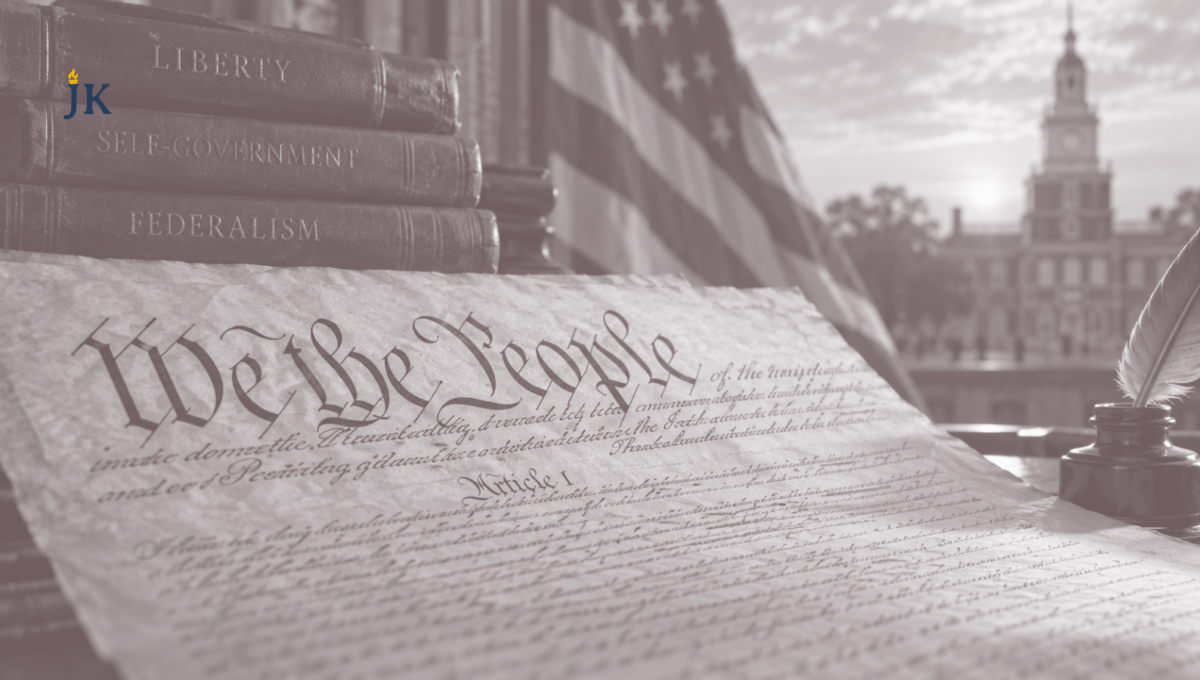
Every September 17, Americans commemorate Constitution Day, marking the signing of the United States Constitution in Philadelphia in 1787.
This year, the occasion carries particular significance.
In 2026, America is celebrating the 250th anniversary of the Declaration of Independence. Two hundred fifty years ago, the Founders declared that government does not grant our rights. Our rights precede government. Governments are instituted among men to secure those rights, deriving their legitimate powers from the consent of the governed.
Eleven years later, the Constitution attempted to put those principles into practice.
The Declaration explained why government exists. The Constitution confronted the harder question: What should government be allowed to do?
That question remains every bit as important today as it was in 1787.
A Constitution Built Around a Distrust of Power
The Constitution is often described primarily as the document that created the federal government. That is true, but incomplete. It also restrained the government it created.
The Founders understood something about political power that Americans would be wise to remember: giving good people power does not guarantee that good people will always possess it.
So they divided power.
Congress would legislate. The executive would execute the laws. Courts would adjudicate disputes. The House and Senate would check one another. The president could veto legislation, while Congress could override that veto. Federal authority itself would be limited to powers granted by the Constitution, leaving enormous authority with the states and the people.
Later, the Bill of Rights would make certain protections even more explicit.
This arrangement can be frustrating, cumbersome, and inefficient. That is not necessarily a defect. It is often THE point.
A government capable of acting instantly, without institutional resistance, competing branches, procedural obstacles, or constitutional limitations may be wonderfully efficient. It may also be dangerous.
The Constitution was not designed to guarantee that politicians could quickly accomplish everything they wanted. It was designed around the recognition that political power itself requires restraint.
Who Governs Is Only Half the Question
We often talk about American government primarily in terms of democracy.
Who won the election? Who has the majority? What does the public want?
Those questions matter. Consent of the governed is foundational to the American experiment. But constitutional government asks another question that is equally important: What may the majority legitimately do?
Winning an election does not erase constitutional limits. Fifty-one percent of voters cannot legitimately vote away the fundamental rights of the other 49 percent. A popular president does not acquire powers absent from his office. A legislative majority does not make every exercise of government authority wise, just, or constitutional.
The American system recognizes something DEEPER than simple majoritarianism.
There are things government should not do even when doing them is popular. There are rights government should not violate even when violating them would be convenient. And there are powers government does not possess even when exercising them might produce an outcome we personally desire.
That is the difference between merely electing rulers and living under constitutional government.
The Constitution Matters Most When It Is Inconvenient
It is easy to defend constitutional principles when they produce the outcome we want. The real test comes when they do not.
Free speech is easy to defend when we agree with the speaker. Due process is easy to defend when we sympathize with the accused. Federalism is easy to champion when Washington is pursuing policies we oppose. Legislative authority is easy to defend when an executive from the opposing political party attempts to circumvent it. Property rights are easy to celebrate until someone’s property stands in the way of a favored government project. Limited government is easy to advocate until government offers to spend taxpayer money on something we personally like.
The temptation is always the same: make an exception just this once.
Our cause is important enough. Our circumstances are unique enough. Our leaders can be trusted. The opposition is dangerous. The normal process takes too long. But constitutional limitations that disappear whenever they become inconvenient are not meaningful limitations at all.
Perhaps the most important discipline of constitutional government is accepting that sometimes government must be told no, even when we desperately want the answer to be yes.
That principle SHOULD transcend political parties.
The Danger of Government by Convenience
Modern politics increasingly rewards immediate action.
Something happens, the public demands a response, politicians promise to act, and anyone who raises questions about authority or constitutional limits risks being accused of caring more about process than results.
But process matters. The separation of powers matters. The legislative process matters. Federalism matters. Due process matters. The constitutional allocation of governmental authority matters.
They matter precisely because political leaders will always be able to offer compelling reasons why this particular situation requires an exception.
That is especially true of executive power. Executives naturally prefer the freedom to act. Legislatures are slow, divided, argumentative, and politically difficult. It can therefore be tempting to celebrate executive action when a president, governor, or local official uses unilateral authority to accomplish something we support. But constitutional principles cannot depend upon who currently occupies the office.
Every power we tolerate in the hands of a political ally becomes a power we may someday watch a political opponent exercise.
The proper question should not be, “Do I like what the government is doing?” It should also be, “Does government legitimately possess the authority to do it?”
Those are very different questions.
Federalism Is a Protection, Not a Guarantee
The Constitution also divided political authority between the federal government and the states. But the original constitutional design went further than simply reserving certain powers to each.
The states themselves were given an institutional role within the federal government. Under the Constitution as originally ratified, members of the House of Representatives were elected directly by the people, while United States senators were chosen by state legislatures. The Senate therefore represented not merely another collection of voters, but the states as political institutions within the federal system.
That arrangement was fundamentally altered by the ratification of the 17th Amendment in 1913, which provided for the direct election of senators.
Whatever the arguments for direct election, the change came with an important constitutional consequence that deserves greater attention: state governments lost one of their most significant structural checks on the federal government.
Before the 17th Amendment, a state legislature had a direct institutional interest in whom it sent to Washington. Senators had reason to remain attentive not only to voters back home, but to the state governments whose authority could be diminished by expanding federal power.
Direct election severed that relationship.
The result is worth considering more than a century later. We routinely debate whether Washington has accumulated too much authority, but rarely ask whether changing the mechanism designed to give states representation within the federal government contributed to that centralization.
The question is not simply whether voters should have a voice. Of course they should. The House was specifically designed to provide direct popular representation, and senators today are democratically accountable to the people of their states. The deeper question is whether something important was lost when both chambers of Congress became directly accountable to voters while state governments lost their representation as states in Washington.
That question becomes particularly relevant whenever federal programs entice states with funding, federal regulations displace state policymaking, or Congress expands Washington’s reach into matters historically handled closer to home. The original Senate gave state governments a seat at the table when those decisions were made. Today, they largely must react to decisions made by a federal government in which they no longer possess that same institutional representation.
Whether one favors repealing the 17th Amendment or not, its effect on the balance of American federalism deserves serious consideration.
Decentralized government can place decisions closer to the people, allow states to pursue different approaches, and prevent every political disagreement from becoming a national struggle for control of Washington. But federalism should not be confused with an assumption that smaller government is automatically limited government.
Washington can violate liberty. So can Texas. So can a county, city, school district, or regulatory agency. Government does not become harmless merely because the officials exercising power live closer to us.
The same principles should therefore follow political power wherever it goes: individual liberty, private property, free expression, due process, transparency, representative government, and meaningful limits on governmental authority.
The Constitution’s division of power is valuable because concentrated power is dangerous, not because any particular level of government is inherently virtuous.
Limited Government Requires More Than Limited-Government Rhetoric
This may be one of the most important lessons for conservatives in particular.
For decades, limited government has been treated as a defining conservative principle. Yet principles are meaningful only when they constrain our own behavior.
It is not limited government to oppose government spending under one administration and embrace it under another. It is not limited government to condemn executive overreach when political opponents exercise it and celebrate it when political allies do. It is not limited government to oppose government picking winners and losers unless the favored industry happens to be one we like. And it is not constitutional conservatism to treat constitutional restraints as procedural nuisances standing in the way of political victory.
A government powerful enough to impose our preferred vision on everyone else is also powerful enough to impose someone else’s vision on us.
That reality should produce humility about political power.
The goal of limited government was never merely to put better people in charge of a powerful state. It was to limit the power of the state regardless of who is in charge.
From 1776 to 1787, and to Today
The Declaration of Independence begins from a remarkable premise: human beings possess rights that government did not give them.
Government therefore exists for the people. The people do not exist for government.
The Constitution attempted to construct political institutions around that understanding.
It was not perfect. The country that ratified it fell profoundly short of the principles proclaimed in 1776, most obviously through the continued institution of slavery. Generations of Americans would struggle, amend the Constitution, fight wars, litigate cases, protest injustice, and demand that the country more faithfully apply its own founding principles.
But the fundamental question confronting the Founders remains ours.
How do we establish government capable of performing its legitimate functions while preventing it from becoming a threat to the liberty it exists to protect?
There will never be a permanent answer.
Political power constantly pushes against its boundaries. Executives discover new justifications for unilateral action. Legislatures expand government programs. Bureaucracies accumulate authority. Local governments test the limits of their jurisdiction. Political movements discover that government power can be useful when directed toward their preferred ends.
And citizens themselves are regularly tempted to abandon restraints when those restraints become inconvenient.
That is why Constitution Day still matters.
Not because an old piece of parchment deserves ceremonial reverence. Not because the Founders were infallible. And not because every constitutional question has an easy answer.
It matters because the fundamental insight behind constitutional government remains true: Power MUST be restrained.
Two hundred fifty years ago, Americans declared that their rights did not come from kings, legislatures, presidents, or governments. Two hundred thirty-nine years ago, the Constitution’s framers attempted to build a government strong enough to govern but constrained enough to remain the servant rather than the master of the people.
That experiment continues.
Constitution Day should therefore be more than a celebration of a document signed in Philadelphia.
It should be an annual reminder that constitutional principles matter most when they are inconvenient, that liberty requires restraints on even those leaders we support, and that sometimes the most important thing the Constitution can say to government is: NO.

Jeramy Kitchen
Holding the line in Austin. Analysis of public policy making its way through the process, campaign finance, and the occasional field note from a concerned taxpayer.