Conservatism, Until It’s Inconvenient
Has conservatism changed? We explore the Republican Party's ideological shift from constitutional conservatism and the TEA Party's limited government principles toward populism, industrial policy, and expanded executive power. It examines whether political principles remain consistent when government authority is exercised by those on the political right and why constitutional limits should outlast partisan victories.
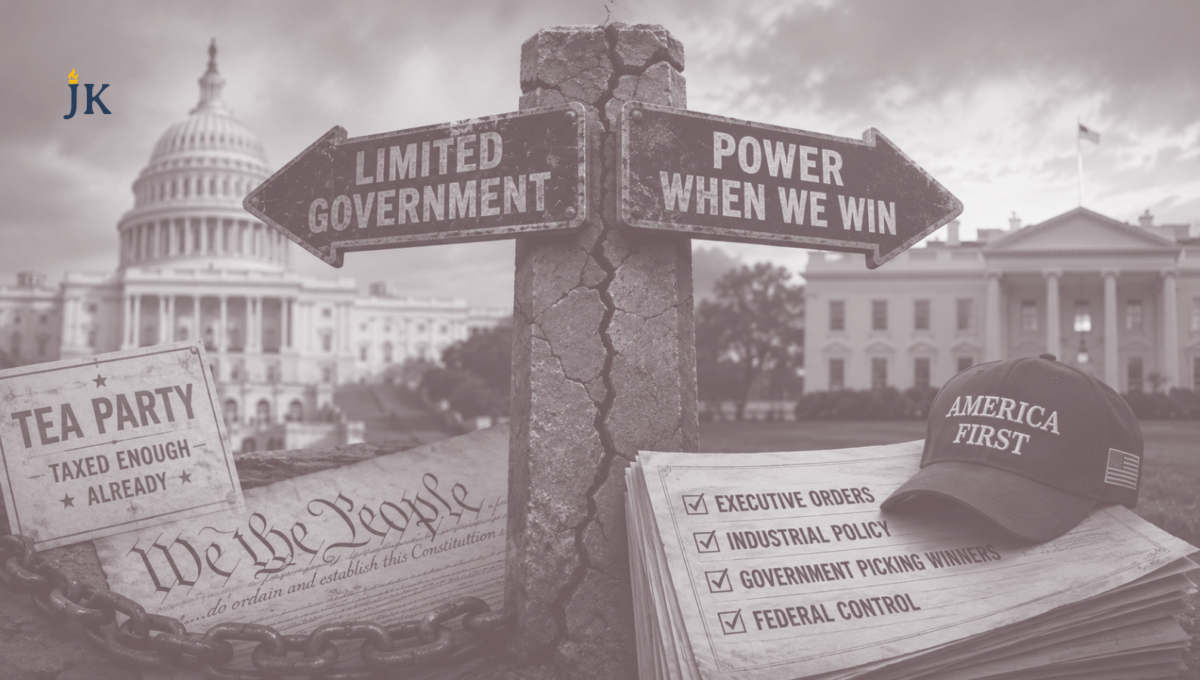
The American right is changing, or has changed… depending on how you look at it.
That should not be a controversial observation, and I am certainly not one of the first individuals to make it. Political coalitions evolve. New voters enter the process. National priorities shift. Ideas that once dominated a movement give way to new philosophies better suited, in the minds of their supporters, to the challenges of the moment.
The Republican Party of today is not the Republican Party of Ronald Reagan, nor is it the Republican Party of the TEA Party.
That evolution is neither inherently good nor inherently bad. Every political movement changes over time.
What deserves an honest conversation, however, is whether many self-proclaimed ‘conservatives’ have acknowledged just how much their own understanding of government’s role has changed.
Increasingly, policies that would have been condemned as examples of federal overreach only a decade ago are now embraced or defended because they are being advanced by a Republican administration (‘muh tribe). At the same time, a new generation of Republican voters has entered the coalition with a very different philosophy than the constitutional conservatives who shaped the party during the 1980s, 1990s, and early 2010s.
These are not the same story. Understanding the difference is essential.
The TEA Party Was Built Around Limiting Government
It has been little more than fifteen years since the TEA Party fundamentally reshaped Republican politics.
The movement emerged in response to the financial crisis, the Troubled Asset Relief Program (TARP), rising federal deficits, the Affordable Care Act (ACA), and an expanding administrative state. Its supporters argued that Washington had become too large, too expensive, and too willing to insert itself into areas better left to individuals, families, states, and private enterprise.
Its principles were straightforward.
The government should remain limited. Federal spending should be restrained. Markets should allocate capital better than politicians. The government should not pick winners and losers. Executive authority should be viewed with skepticism regardless of who occupied the White House.
Whether one agreed with every position or not, the underlying philosophy was remarkably consistent. The objective was to reduce the size, scope, and influence of the federal government.
The Promise and Decline of the TEA Party
On a more personal level, this transformation is disappointing because I genuinely believed in what the TEA Party represented when it first emerged.
At its inception, the movement felt remarkably pure. It was not driven by political consultants, influencers, or professional activists. It was fueled by ordinary Americans who sincerely believed the federal government had exceeded its constitutional role. “Taxed Enough Already” was more than a clever acronym. It represented a broader conviction that Washington had become too large, too expensive, and too comfortable spending money it did not have while accumulating powers it was never intended to possess.
People showed up because they believed in principles. They believed constitutional limits mattered. They believed the federal government should be smaller regardless of which party controlled it.
Looking back, I cannot help but wonder whether what happened next was almost inevitable.
As the movement grew, it became increasingly attractive to political operatives, media personalities, advocacy organizations, consultants, and professional activists. Many undoubtedly joined with good intentions. Others recognized an opportunity to channel an energized grassroots movement toward their own objectives.
Before long, the movement seemed to lose its singular focus.
Rather than remaining centered on constitutional government, fiscal restraint, and limiting federal power, it became a vehicle for nearly every political grievance imaginable. Every controversy became an existential crisis. Every news cycle demanded outrage. Every issue became another reason to keep supporters mobilized, donations flowing, audiences engaged, and influence growing.
The movement became perpetually angry. Eventually, it became rudderless.
That is not meant as a criticism of the thousands of sincere grassroots activists who devoted their time because they genuinely wanted to restore constitutional government. Quite the opposite. They were the movement’s greatest strength.
My disappointment is that many of those individuals were gradually led away from the very principles that brought them into politics in the first place.
Somewhere along the way, personalities began replacing principles. Political victories began taking precedence over constitutional consistency.
And for many, limiting government ceased to be the objective. Instead, the objective became ensuring the “right people” controlled a government that continued to grow.
That is a profoundly different philosophy than the one that first inspired so many Americans to become politically engaged.
The Republican Coalition Has Expanded
President Trump did more than win elections; he built a new coalition.
Millions of Americans who had never identified with Reagan conservatism or the TEA Party became politically engaged because of concerns over immigration, trade, manufacturing, globalization, cultural issues, border security, and America’s declining industrial base.
Many of these voters are not traditional constitutional conservatives. They are economic nationalists. They are populists.
They generally view government less as a necessary evil and more as a legitimate tool for protecting American workers, rebuilding domestic manufacturing, confronting foreign adversaries, strengthening families, and advancing the national interest.
There is nothing inherently inconsistent about that worldview. It represents a different governing philosophy.
The mistake is assuming it is identical to the limited-government conservatism that defined much of the Republican Party only a decade ago.
Industrial Policy Has Returned to the Right
One of the clearest signs of this philosophical shift is the renewed embrace of industrial policy.
For decades, conservatives criticized the federal government for directing investment, subsidizing favored industries, and influencing private markets. Those policies were viewed as distortions of free enterprise that concentrated economic decision-making in Washington instead of allowing consumers and private investment to determine outcomes.
Today, many Republicans openly support “strategic government intervention.”
Federal efforts to encourage domestic manufacturing, strengthen supply chains, secure critical minerals, rebuild semiconductor production, acquire interests in strategically important companies, and otherwise shape economic outcomes are increasingly defended as necessary components of national security.
Those arguments deserve serious consideration.
America unquestionably faces strategic challenges from adversaries such as China that previous generations did not confront to the same extent, but acknowledging those realities should not require redefining long-established political terms.
Using federal power to direct investment toward selected industries is industrial policy.
Whether one supports it or opposes it, honesty requires calling it what it is.
Trump Accounts Reflect a Different Vision of Government
The recently established ‘Trump Accounts’ provide another example of this evolution.
Supporters argue that the accounts promote ownership rather than dependency. They encourage saving, investing, and financial literacy instead of expanding traditional welfare programs.
Those are thoughtful arguments worthy of debate, but they are not traditionally conservative arguments.
The federal government is still collecting taxpayer dollars to provide investment capital through a federally designed program. Private investment is included thereafter.
One may conclude that such a policy is worthwhile.
That conclusion does not automatically make it an example of limited government.
Where the Inconsistency Actually Exists
This is where an important distinction must be made.
Many newer members of today’s Republican coalition have never claimed to be constitutional conservatives.
They are pursuing a different political philosophy centered on national resilience, strategic independence, stronger borders, and rebuilding American industry. If they support tariffs, industrial policy, or selective government intervention, there is little inconsistency because those positions align with their underlying worldview.
The inconsistency lies elsewhere.
It lies with those who spent years warning about corporate welfare, condemning government ownership, opposing federal intervention in private markets, criticizing executive overreach, and insisting that Washington should remain as limited as possible, only to defend many of the same governing tools when employed by a Republican administration.
Supporting a president does not require abandoning the principles that first attracted millions of Americans to the conservative movement.
Political loyalty and political philosophy are not the same thing.
The Danger of Expanding Executive Power
Perhaps the most concerning aspect of this ideological shift is not simply a greater willingness to use federal authority. It is the growing willingness to expand executive power because the “right” person currently occupies the Oval Office.
The Constitution was never designed around trusting individual leaders. It was designed around limiting every leader.
Every executive authority claimed today becomes a precedent tomorrow. Every expansion of presidential power survives the next election. Every regulatory shortcut, emergency declaration, executive directive, or novel interpretation of federal authority becomes another tool available to the next administration.
Political victories are temporary. Institutional power is often permanent.
Many conservatives understandably appreciate seeing executive authority used to pursue objectives they support. But the authorities exercised today will not disappear when control of the White House changes hands.
The question constitutional conservatives have traditionally asked is remarkably simple: What happens when the other side controls this power?
If the answer is deeply concerning, perhaps the authority should never have been expanded in the first place.
The government should not become more powerful simply because our preferred political coalition temporarily controls it.
Principles Should Outlast Political Victories
Political movements evolve. Ideas evolve. Coalitions evolve.
There is nothing wrong with acknowledging that the Republican Party is no longer ideologically identical to the one that existed fifteen years ago.
If the American right is embracing a philosophy that accepts a more active federal role in pursuing national objectives, then that debate should happen openly and honestly.
Likewise, those who continue to believe constitutional conservatism, federalism, limited government, and separation of powers remain the best guide for governing should not feel pressured to redefine those principles simply because doing so is politically expedient.
Every political movement eventually faces the same test. Do its principles remain consistent when its own leaders hold power?
For many of the newer populists within today’s Republican coalition, that question may not apply because they are advancing a genuinely different philosophy. But for those who once rallied under the banner of limited government, the question is unavoidable.
Have the principles changed? Or have they merely become inconvenient?
Because if constitutional limits only matter when our political opponents hold power, then they were never really principles at all.
They were preferences.

Jeramy Kitchen
Holding the line in Austin. Analysis of public policy making its way through the process, campaign finance, and the occasional field note from a concerned taxpayer.