A Liberty-First Ranking of Every U.S. President
A liberty-first ranking of every U.S. president based on individual liberty, personal responsibility, free enterprise, private property rights, and limited government, offering a very different view of presidential “greatness.”
Presidential rankings usually ask some version of the same question: Who was the most consequential? Who exercised the greatest leadership? Who fundamentally changed the country?
I am asking a different question. Which presidents did the best job protecting liberty?
My ranking evaluates each president through five principles: Individual Liberty, Personal Responsibility, Free Enterprise, Private Property Rights, and Limited Government.
That produces a very different list from the rankings traditionally produced by historians, academics, or political commentators.
A president does not receive extra credit here simply because he created a major federal program, expanded the power of the presidency, transformed American government, or responded aggressively to a crisis. In fact, some of the actions that make presidents “great” in conventional historical rankings count against them under a liberty-first standard.
Likewise, this is not a partisan ranking. Republican presidents can score poorly. Democratic presidents can receive credit where it is deserved. Presidents I may agree with on some issues lose points when they violate the same principles I am using to evaluate everyone else. Nor does placement in a high tier mean a president was flawless. Every presidency presents contradictions.
The question is comparative: When the entire record is considered, did this president generally leave Americans freer or less free?
There have been 45 individual men to serve as president, with Grover Cleveland and Donald Trump serving nonconsecutive terms. I rank the individual presidents rather than treating their separate terms as different people.
Why I Made This Ranking
This exercise started as a response to a presidential ranking recently shared by President Donald Trump himself.
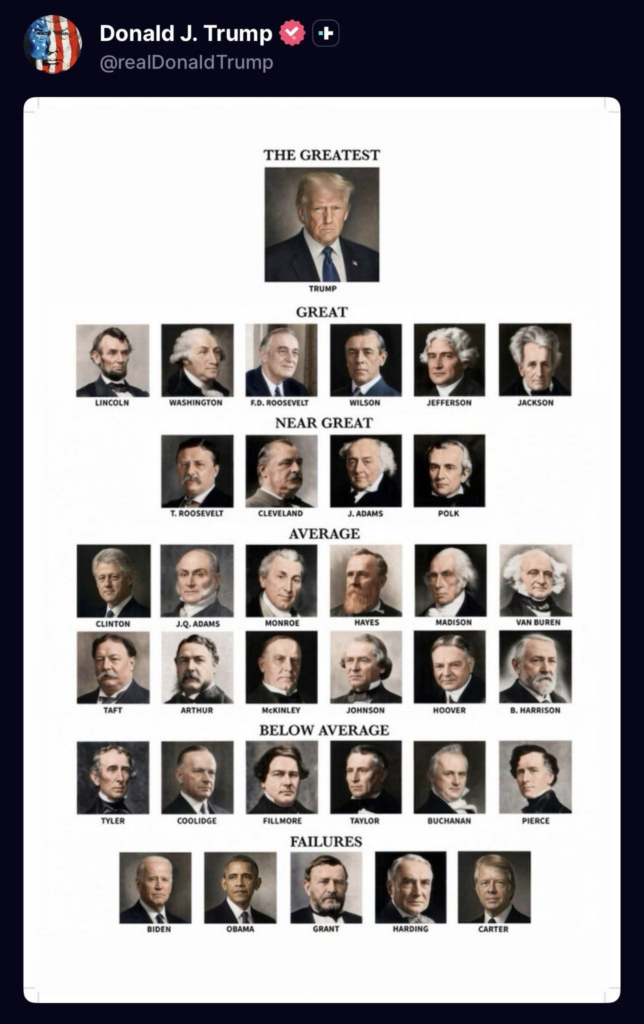
The list had some obvious problems. It omitted several presidents entirely, while placing others in categories that, from a liberty-first perspective, are difficult to defend. Woodrow Wilson and Franklin D. Roosevelt were labeled “Great.” Calvin Coolidge was placed “Below Average.” Warren Harding, Ulysses S. Grant, and Jimmy Carter were listed as “Failures.” Almost certainly, the President posted this for the sake of engagement/argumentation.
Trump also placed himself alone in a category labeled “The Greatest.” Not surprising, but certainly NOT true either.
That ranking may make sense if the standard is political admiration, historical consequence, or personal preference. But those are not the standards I wanted to use.
Instead, I wanted to ask a more consistent question: How well did each president protect individual liberty, personal responsibility, free enterprise, private property rights, and limited government?
That produces a very different list.
So, here is my list and brief explanations of each ranking below:
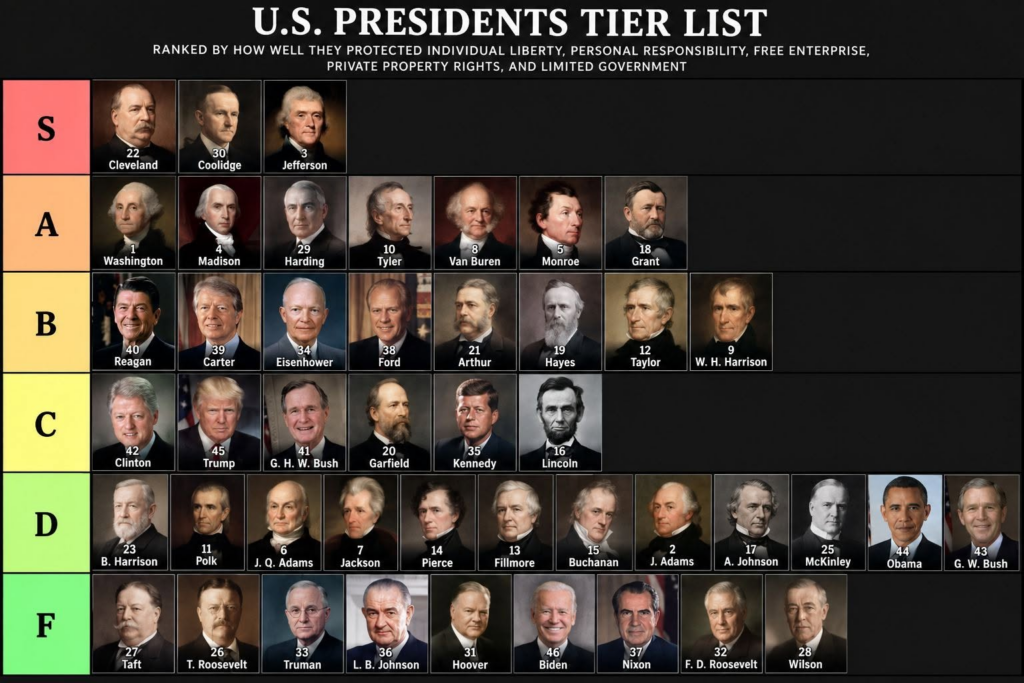
S Tier
1. Grover Cleveland
Cleveland takes the top spot because few presidents demonstrated a stronger presumption against federal spending, subsidies, political favoritism, and unnecessary government intervention. He repeatedly vetoed legislation he believed exceeded the proper role of Washington, resisted protectionism, defended sound money, and treated taxpayer funds as something government had an obligation to protect rather than distribute. His record was not perfect, but his governing instinct was unusually consistent: the federal government should do less, spend less, and grant fewer favors.
2. Calvin Coolidge
Coolidge paired limited-government rhetoric with actual policy. His administration reduced tax rates, restrained federal expenditures, substantially reduced the national debt, and generally favored private enterprise over federal economic management. Coolidge understood economic liberty as inseparable from individual liberty and regularly warned against government becoming the provider, manager, and regulator of everyday life. There are blemishes in his record, particularly regarding immigration policy, but few modern presidents governed with a stronger commitment to keeping Washington restrained.
3. Thomas Jefferson
Jefferson entered office deeply suspicious of concentrated political power and substantially reduced federal taxes, expenditures, debt, and the size of the military establishment. His administration abolished internal taxes and generally sought to decentralize government. There are significant contradictions. The Louisiana Purchase stretched Jefferson’s own constitutional philosophy, while the Embargo Act represented a severe intrusion on free enterprise. Even with those shortcomings, the overall direction of his presidency was toward a smaller and less intrusive federal government.
A Tier
4. George Washington
Washington’s greatest contribution to limited government may have been the precedents he established. He voluntarily relinquished power, respected the constitutional structure of the new government, and helped establish the presidency as something other than an elected monarchy. The Whiskey Rebellion and the federal government’s use of force to enforce the whiskey tax deserve more scrutiny than they often receive and count against him here. Still, Washington’s restraint in defining presidential authority earns him a high placement.
5. James Madison
Madison’s role in developing America’s constitutional architecture does not exempt his presidency from scrutiny, but his underlying suspicion of centralized power remained significant. The War of 1812 brought taxation, military expansion, and wartime government that work against his ranking. Madison also became somewhat more receptive to federal economic initiatives after the war. Even so, his presidency remained grounded more firmly in constitutional limitation than those of most who followed.
6. Warren G. Harding
Harding’s reputation has suffered considerably because of scandals surrounding members of his administration, but his liberty record deserves a separate evaluation. Harding reduced wartime government, cut federal expenditures, supported tax reductions, and released political prisoners imprisoned during the Wilson administration, including socialist leader Eugene Debs. His “return to normalcy” reflected a genuine retreat from Wilson-era centralization. Whatever the personal failures of people around him, Harding’s policy direction was substantially toward less government.
7. John Tyler
Tyler was frequently at odds with his own party because he refused to embrace much of the Whig economic program. He vetoed attempts to establish another national bank, resisted federal spending initiatives, and maintained a relatively narrow understanding of national power. His record on slavery and the circumstances surrounding Texas annexation complicate his legacy considerably, but on the direct questions of federal economic power and limited government, Tyler ranks surprisingly well.
8. Martin Van Buren
Van Buren generally favored limited federal involvement in the economy and deserves significant credit for establishing the Independent Treasury, separating federal finances from private banking institutions. His response to the Panic of 1837 largely resisted demands for sweeping federal intervention. There are legitimate reasons to move him lower, particularly when his broader record is considered, but his presidency still stands out for resisting the idea that Washington should manage the economy whenever hardship occurs.
9. James Monroe
Monroe governed during an era of relatively restrained federal government, although his presidency also reflected the growing nationalist impulse toward federally supported infrastructure and economic development. He generally exercised presidential power with restraint and operated within a constitutional culture that still expected the federal government’s role to remain limited. His record is not as consistently libertarian as Jefferson’s, but it compares favorably with most later administrations.
10. Ulysses S. Grant
Grant presents an important lesson about what limited government actually means. Federal power used to protect constitutional rights is not inherently inconsistent with liberty. Grant’s administration confronted organized racial terrorism during Reconstruction and used federal authority to protect newly freed Americans whose rights state and local governments were failing to defend. His administration also generally maintained relatively restrained economic policies. Corruption around his administration hurts his ranking, but protecting individuals against violence and state-sanctioned oppression counts strongly in his favor.
B Tier
11. Ronald Reagan
Reagan restored an important political argument that government itself could be the problem rather than the solution. His administration cut marginal tax rates, pursued substantial deregulation, and forcefully defended free enterprise. But Reagan’s liberty record is much more complicated than conservative mythology sometimes acknowledges. Federal spending and debt continued growing, the drug war expanded, civil asset forfeiture accelerated, and his record on the Second Amendment included serious shortcomings. Iran-Contra also raises important questions about executive power and circumventing constitutional constraints. He may ultimately belong lower within this tier.
12. Jimmy Carter
Carter may be the most surprising placement on the list. His broader presidency was troubled, but a liberty-first ranking requires giving credit where it is due. Carter helped dismantle enormous government-created barriers through airline, trucking, railroad, and energy deregulation. Those reforms expanded competition and reduced federal control over major sectors of the economy. His appointment of Paul Volcker to lead the Federal Reserve also proved consequential in confronting inflation. Carter was hardly a limited-government president overall, but his deregulatory legacy deserves far more recognition than it normally receives.
13. Dwight D. Eisenhower
Eisenhower governed with a comparatively restrained temperament and showed genuine concern about the growth of permanent government institutions, most famously warning about the military-industrial complex. His fiscal record was more restrained than many later presidents. At the same time, the interstate highway system dramatically increased federal involvement in transportation, while Cold War intelligence operations and covert interventions raised significant individual-liberty and executive-power concerns. His record lands on the positive side overall, but not without substantial qualifications.
14. Gerald Ford
Ford’s presidency represented something of a retreat from the excesses of the Nixon years. He regularly used the veto against congressional spending and generally favored deregulation and market-oriented reforms. His presidency was short and inherited enormous institutional problems, limiting how much can reasonably be attributed to him. Ford did not fundamentally shrink the federal government, but his governing instinct tended to be more restrained than many presidents of the twentieth century.
15. Chester A. Arthur
Arthur is another president whose record is better than popular memory suggests. He supported civil service reform, vetoed excessive river-and-harbor spending, and favored some reductions in tariffs. He showed a willingness to resist patronage even though he had risen through machine politics himself. The Chinese Exclusion Act is a major strike against individual liberty and weighs heavily against him, but his broader approach to federal administration was relatively restrained.
16. Rutherford B. Hayes
Hayes favored civil service reform, sound fiscal policy, and relatively restrained government. He often resisted inflationary monetary proposals and sought to reduce political patronage. His decision to end federal Reconstruction enforcement remains deeply controversial because of what followed for the rights of Black Americans in the South. His economic and governmental record was restrained, but that larger civil-liberties consequence prevents a higher placement.
17. Zachary Taylor
Taylor’s presidency was too short to produce an extensive governing record, making any placement inherently tentative. He generally resisted the expansion of slavery into newly acquired territories and did not display particularly expansive ambitions for federal power. Because he served only about sixteen months, however, ranking him much higher would require evaluating intentions rather than presidential actions. He lands in B primarily because what record exists contains relatively few major departures from the liberty framework.
18. William Henry Harrison
Harrison served just 31 days before dying, which makes meaningful evaluation nearly impossible. There simply was not enough presidency to produce either a substantial record for liberty or a substantial record against it. Rather than rewarding or punishing him for policies he never had the opportunity to implement, I place him near the bottom of B as essentially an incomplete grade.
C Tier
19. Bill Clinton
Clinton’s presidency produced a genuinely mixed liberty record. NAFTA, welfare reform, relatively restrained spending after the Republican takeover of Congress, and several deregulatory measures count in his favor. Against those are the 1994 crime bill, expanded federal criminal law, gun restrictions, civil asset forfeiture, surveillance authorities, and continued growth of the administrative state. Clinton’s presidency illustrates why partisan labels do not map neatly onto a liberty ranking.
20. Donald Trump
Trump’s placement remains provisional because his second presidency is ongoing. He deserves substantial credit for tax reductions, deregulation, efforts to dismantle parts of the administrative state, and judicial appointments that helped challenge expansive agency power. But tariffs are a major intrusion on free enterprise, federal spending has been a persistent problem, and his use of emergency and executive authority raises serious limited-government concerns. His record on firearms also includes the first-term bump-stock ban. The positives and negatives currently put him near the middle rather than either extreme.
21. George H. W. Bush
Bush generally embraced free trade and market economics, but his administration also expanded regulation and federal spending. His decision to break his “no new taxes” pledge receives enormous political attention, but the larger liberty concerns include major regulatory legislation and continued growth in Washington’s domestic role. He was more restrained in temperament than many presidents, but temperament alone does not equal limited government.
22. James A. Garfield
Garfield served only a few months before being shot and ultimately dying from his wounds, leaving very little presidential record to evaluate. He supported civil service reform and expressed generally limited-government economic instincts, but there simply was not enough time for those views to become a meaningful governing legacy. Like Harrison, his placement reflects uncertainty more than a strong judgment.
23. John F. Kennedy
Kennedy’s economic record includes meaningful positives, particularly his support for substantial reductions in marginal tax rates that were ultimately enacted after his death. But Cold War intervention, surveillance, intelligence operations, and an increasingly powerful national-security establishment weigh against him. Kennedy does not fit easily into either a limited-government or big-government caricature, which is why he lands in the middle.
24. Abraham Lincoln
Lincoln is perhaps the hardest president on the entire list to rank. Emancipation and the destruction of slavery represent one of the greatest expansions of individual liberty in American history. At the same time, his administration suspended habeas corpus, arrested political opponents, tolerated censorship, imposed conscription, introduced new federal taxation, and dramatically expanded executive power during the Civil War. Those are extraordinary forces pulling in opposite directions. The contradiction is precisely why I place Lincoln in C rather than near either end of the scale.
D Tier
25. Benjamin Harrison
Harrison presided over significant growth in federal expenditures, embraced high protective tariffs, and signed the Sherman Antitrust Act, helping expand federal intervention into private economic activity. His administration reflected the growing belief that Washington should take a more active role in shaping economic outcomes. He was nowhere near the scale of later Progressive presidents, but the direction of government moved away from the principles used for this ranking.
26. James K. Polk
Polk’s domestic economic record was surprisingly restrained. He reduced tariffs, restored the Independent Treasury, and generally maintained relatively disciplined federal spending. The enormous negative is the Mexican-American War and the broader expansion of executive war-making power surrounding it. Under a liberty-first standard, restrained economic policy cannot completely overcome the consequences of using presidential power to wage an expansionist war.
27. John Quincy Adams
Adams was intellectually formidable and personally committed to many admirable causes, but his vision of government was considerably more nationalist than that of Jeffersonian limited-government presidents. He supported federally directed infrastructure, scientific institutions, and economic development under what became known as the American System. Many of those ideas may appear unobjectionable today, but they reflected an increasingly expansive interpretation of federal power.
28. Andrew Jackson
Jackson’s destruction of the Second Bank of the United States and hostility toward concentrated government-backed financial privilege deserve significant credit. But those achievements coexist with enormous violations of liberty. Indian removal, forced displacement of Native tribes, and Jackson’s aggressive conception of presidential authority weigh heavily against him. His presidency demonstrates that opposing one form of concentrated power does not automatically make someone a defender of individual rights.
29. Franklin Pierce
Pierce generally favored limited federal economic government, lower tariffs, and restrained spending. Those policies would normally place him considerably higher. But his enforcement of fugitive slave laws and role in the sectional crisis surrounding the Kansas-Nebraska Act represent enormous failures on individual liberty. Economic restraint cannot compensate for federal power being used to deny human beings their most fundamental rights.
30. Millard Fillmore
Fillmore likewise governed with relatively limited economic ambitions, but his aggressive enforcement of the Fugitive Slave Act is devastating under a liberty-first framework. Federal authority was employed to capture and return individuals who had escaped slavery, while citizens in free states were compelled to participate in that system. That violation of individual liberty overwhelms much of what might otherwise have been a relatively unremarkable limited-government presidency.
31. James Buchanan
Buchanan was not a great architect of federal economic expansion, but his administration’s handling of slavery and the sectional crisis is disastrous from an individual-liberty perspective. His support for pro-slavery policies and failure to confront the constitutional crisis overtaking the country substantially outweigh the more limited scope of federal domestic government during his tenure.
32. John Adams
Adams deserves enormous respect as a Founder, but this ranking evaluates his presidency rather than his entire life. The Alien and Sedition Acts are among the clearest early examples of federal power being turned against political speech and dissent. Americans were prosecuted for criticizing their government. Under a standard that places individual liberty and free expression near the center, that is an enormous strike against his presidency.
33. Andrew Johnson
Johnson’s presidency followed emancipation but repeatedly obstructed congressional efforts to secure the rights of newly freed Americans. His approach to Reconstruction helped allow former Confederate states to impose systems that severely restricted Black liberty and political participation. His relatively restrained economic philosophy cannot overcome those failures on basic individual rights and constitutional equality.
34. William McKinley
McKinley embraced protectionist tariffs and presided over America’s emergence as an overseas imperial power following the Spanish-American War. The acquisition and administration of overseas territories represented a significant departure from a restrained republic and raised fundamental questions about governing people without the same constitutional political status enjoyed by Americans at home. Protectionism further weighs against him on free enterprise.
35. Barack Obama
Obama’s administration substantially expanded federal regulatory and administrative authority. The Affordable Care Act, Dodd-Frank, executive rulemaking, surveillance, drone policy, and expansive interpretations of executive authority all weigh against him. There were areas of criminal-justice reform and some civil-liberties positives, but the overall governing philosophy placed considerable faith in centralized administrative solutions. D may even prove generous depending on how heavily executive and regulatory power are weighted.
36. George W. Bush
Bush began with tax cuts but ultimately presided over enormous expansions of federal power. The PATRIOT Act, warrantless surveillance, creation of the Department of Homeland Security and TSA, No Child Left Behind, Medicare Part D, TARP, the expansion of federal spending, and broad assertions of wartime executive authority all work against him. Whatever the security rationale behind individual policies, the cumulative result was a much larger and more intrusive federal government.
F Tier
37. William Howard Taft
Taft was less aggressive in temperament than Theodore Roosevelt, and I am increasingly persuaded that F may be too harsh. Nevertheless, his administration continued the Progressive shift toward greater federal economic management. Taft pursued even more antitrust cases than Roosevelt and signed the Mann-Elkins Act, expanding the authority of the Interstate Commerce Commission. He belongs below average under this framework, although on reconsideration I could see moving him into D.
38. Theodore Roosevelt
Roosevelt helped transform the presidency into an engine for active national government. His administration aggressively pursued antitrust enforcement, expanded federal regulation, increased executive control over public lands, and embraced the Progressive belief that Washington should actively supervise economic and social outcomes. Roosevelt’s larger-than-life personality often overshadows the institutional legacy. Under a limited-government framework, helping establish the intellectual and political foundations of the modern regulatory state counts heavily against him.
39. Harry S. Truman
Truman continued much of the New Deal state and dramatically expanded presidential authority in foreign affairs. His attempt to seize the nation’s steel mills during the Korean War represents one of the clearest examples of executive overreach in modern history and produced the landmark Youngstown decision limiting presidential power. Loyalty programs, conscription, wartime authority, and federal economic intervention further pull his record toward the bottom.
40. Lyndon B. Johnson
Johnson presents a genuine conflict because the Civil Rights Act and Voting Rights Act dismantled government-enforced systems that denied basic liberty and equal protection to millions of Americans. Those achievements matter enormously. Yet the Great Society permanently expanded federal involvement in health care, welfare, education, housing, and economic regulation. Vietnam, surveillance, and executive power add further concerns. The expansion of individual civil rights was historic, but so was the expansion of centralized government.
41. Herbert Hoover
The caricature of Hoover as a laissez-faire president who simply watched the Great Depression unfold is difficult to sustain. His administration encouraged wage maintenance, expanded public works and federal spending, intervened in agriculture, signed the protectionist Smoot-Hawley Tariff, and eventually supported substantial tax increases. Hoover’s response helped establish the idea that Washington should actively manage national economic crises, even before the far larger interventions of the New Deal.
42. Joe Biden
Biden’s administration embraced large federal spending packages, industrial subsidies, expansive regulation, student-loan cancellation through contested executive authority, vaccine mandates, protectionist industrial policy, and broad administrative interpretations of federal power. His presidency consistently relied on Washington to direct economic and social outcomes. Under a framework centered on limited government, free enterprise, and individual choice, that produces a very low ranking.
43. Richard Nixon
Nixon’s presidency was extraordinarily hostile to several of these principles. Wage and price controls represented direct federal management of private economic decisions. His administration expanded the drug war, regulatory government, surveillance, and executive power while creating or strengthening major federal agencies. Watergate revealed a willingness to misuse government authority for political purposes. Nixon’s abandonment of monetary arrangements and economic intervention further damaged his free-enterprise record.
44. Franklin D. Roosevelt
FDR fundamentally transformed the relationship between Americans and the federal government. The New Deal dramatically expanded spending, regulation, agricultural controls, labor intervention, economic planning, and the administrative state. Roosevelt attempted to reshape the Supreme Court when it resisted portions of his agenda and ordered the internment of Japanese Americans during World War II, one of the most severe violations of civil liberty in modern American history. His historical consequence is undeniable. Under this standard, that does not make the consequence good.
45. Woodrow Wilson
Wilson ranks last because his presidency combines nearly every form of government expansion this framework is designed to scrutinize. His administration imposed wartime censorship, prosecuted dissent, imprisoned political opponents, embraced conscription and economic controls, and presided over the implementation of the federal income tax and creation of the Federal Reserve. His administration also segregated parts of the federal workforce. Wilson’s broader Progressive philosophy rejected many constitutional restraints in favor of centralized administrative expertise. Few presidencies moved so consistently away from individual liberty and limited government.
Greatness Is Not the Same as Liberty
There will be plenty to disagree with here. I already have several placements I could be persuaded to move after digging further into individual records.
That is part of the point.
A tier list compresses complicated presidencies into a simple visual. The interesting discussion begins when we ask why someone belongs where they do.
Too often presidential greatness is measured by action. Presidents who created enormous programs, accumulated new authority, transformed institutions, or fundamentally altered American government are rewarded simply because their actions were consequential.
But government can be consequential while making people less free.
I prefer another standard.
- Did the president protect individual liberty?
- Did he expect individuals to exercise personal responsibility rather than turning every problem over to Washington?
- Did he allow people to engage freely in commerce?
- Did he respect private property?
- Did he restrain federal power rather than constantly searching for new ways to exercise it?
No president answers all five questions perfectly. But asking them produces a very different picture of American history. And perhaps that is more useful than simply asking who was “great.”
The measure of a president should not be how much power he exercised. It should include how much power he was willing to leave with the people.

Jeramy Kitchen
Holding the line in Austin. Analysis of public policy making its way through the process, campaign finance, and the occasional field note from a concerned taxpayer.